
Austin, TX, USA, April 15, 2025 (GLOBE NEWSWIRE) — Custom Market Insights has published a new research report titled “Transformer Core Market Size, Trends, and Insights” that covers various aspects like product types (Distribution Transformer, Power Transformer, Instrument Transformer), winding types (Two Winding, Auto-transformer), cooling methods (Dry Type, Self-Cooled), insulation types (Gas, Oil, Solid, Air), applications (Residential & Commercial, Utility, Industrial), and regions, along with an overview of the global industry, statistical data, competitive analysis, market share, outlook, and forecasts for 2025–2034.
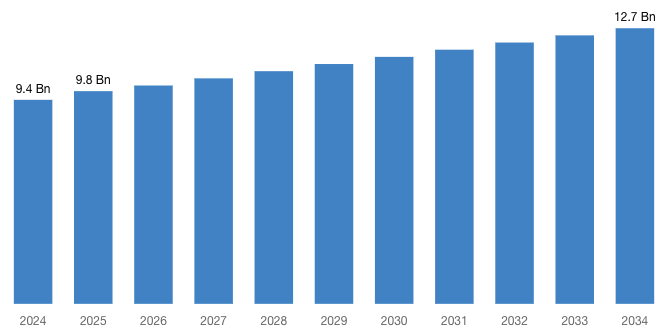
“According to the latest research study, the demand of global Transformer Core Market size & share was valued at approximately USD 9.4 billion in 2024 and is expected to reach USD 9.8 billion in 2025 and is expected to reach a value of around USD 12.7 billion by 2034, at a compound annual growth rate (CAGR) of about 3.1% during the forecast period 2025 to 2034.”
Click Here to Access a Free Sample Report of the Global Transformer Core Market @ https://www.custommarketinsights.com/request-for-free-sample/?reportid=68655
Transformer Core Market Overview
According to industry experts at CMI, to lower energy losses from eddy currents, laminated sheets of ferromagnetic material—such as silicon steel—are assembled to form the magnetic core of a transformer. It provides the low-reluctance channel’s magnetic flux and allows efficient electromagnetic induction energy transfer between the primary and secondary windings.
Growing power consumption resulting from industrialization and urbanization is driving the demand for transformers and their cores. Public and private sector projects in modernizing old power infrastructure and expanding grid networks also boost transformer core demand.
Transformer Core Market Growth Factors and Dynamics
Technological advancements in transformer core materials
Technological advancements are expected to drive the market growth. By means of Diamond Pattern-Enhanced (DPE) cellulose and Nomex-coated sheets, improvements in insulation materials have raised transformer thermal class by up to 10°C.
This increases transformer lifetime and enhances power-handling capability without adding weight or size. Apart from lower energy losses, transformer efficiency has been significantly boosted by advancements in transformer core materials, hence improving general performance.
Unlike conventional crystalline materials, amorphous metal alloys—like Metglas—reduce core losses by as much as 70–80% by being made by rapidly cooling molten metal to produce a non-crystalline structure that generates low coercivity, low electrical resistance, and high magnetic susceptibility. Thus, technological advancements in transformer core materials drive the market growth.
Request a Customized Copy of the Transformer Core Market Report @ https://www.custommarketinsights.com/request-for-customization/?reportid=68655
Stringent energy efficiency regulations
Strict energy efficiency rules have significantly impacted the market for transformer cores by driving material and design innovations to meet higher performance criteria. For instance, the Department of Energy (DOE) modified its energy efficiency standards for distribution transformers in an attempt to reduce energy losses and increase system resilience.
The DOE first proposed that distribution transformers should include roughly 95% amorphous electrical steel. The last rule, however, allows manufacturers greater flexibility by allowing roughly 75% to keep being grain-oriented electrical steel (GOES). The compliance deadline has also been doubled to two years to reflect developments in the sector.
Complex manufacturing process
The complex and time-consuming nature of the transformer core production process has a big impact on the market dynamics. For the best transformer performance, premium materials—like cold-rolled grain-oriented (CRGO) silicon steel—are necessary. To diminish excitation current and core losses, methods such as step-lap stacking are used to decrease local flux concentration.
Report Scope
| Feature of the Report | Details |
| Market Size in 2025 | USD 9.8 Billion |
| Projected Market Size in 2034 | USD 12.7 Billion |
| Market Size in 2024 | USD 9.4 Billion |
| CAGR Growth Rate | 3.1% CAGR |
| Base Year | 2024 |
| Forecast Period | 2025-2034 |
| Key Segment | By Product, Winding, Cooling, Insulation, Application and Region |
| Report Coverage | Revenue Estimation and Forecast, Company Profile, Competitive Landscape, Growth Factors and Recent Trends |
| Regional Scope |